|
Click thumbs to enlarge. Click- drag to move. Open several.
Netherlands
Where is Delft?
Delft is in the middle of the Randstad, the urban conglomeration that
made Holland, in the Golden Age and now, the most densely populated
area in Europe. Geographically, it is in the marshy flat delta where
the Rhine and Maas (Meuse) rivers flow into the North Sea. Without the
extensive Dutch water control system, Delft would be under water, along
with the nearby cities of Leiden 11 miles (18 km) to the north and
Rotterdam 8 miles (13 km) to the south.
|
Delft old city
The binnenstad or inner city of Delft is everything within
the singel or wide surrounding moat. The old city is roughly
rectangular, oriented northwest to southeast, a mile (1.6 km) long by
half a mile (.8 km) wide. This shape was established in the 1400's and
six gates controlled access: Rotterdamse Poort, Schiedamse Poort,
Waterslootse Poort, Haagpoort, Koepoort. Only one remains, the
Oostpoort, on the right edge of this image.
The viewpoint for Vroom's view of Delft (see below) is in the bottom
right corner of this image. The street there, the Michiel de Ruyterweg,
is what became of the muddy road running off the bottom center of
Vroom's painting.
|
Microscope
Specimen-side view
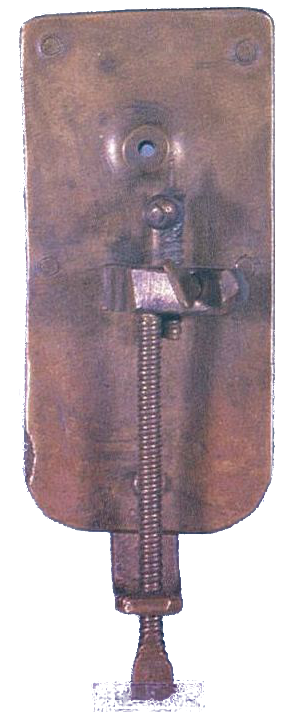
These are the little hand-made devices, most often brass, all a little
different, that easily fit into van Leeuwenhoek's palm. With them, he
discovered a whole new world that no one even suspected.
The specimen was impaled on or stuck to the pin. The screws moved the
specimen, unlike modern microscopes, where the lens moves and the
specimen stays still.
|
Eye-side view
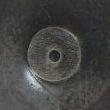
Because the lens was so small, around a millimeter in diameter, the
specimen and the observer's eye had to be that close to the lens. This
made van Leeuwenhoek's microscope very hard to use and, in fact, made
its single-lens design a dead-end in the history of the microscope,
which has two or more lenses.
|
Animalcules
bacteria
Van Leeuwenhoek had, and was willing to use, a microscope much more
powerful than anyone else had ever had. Thus, everything that he saw,
he was the first human ever to see. They had no names, so he called
them animalcules. While certainly some bacteria are the enemies of
human life, most bacteria, as van Leeuwenhoek seemed to understand, are
our friends.
His personal showcase was a microscope that would reveal the
circulation of blood through the capillaries of a live eel. However,
looking back after three hundred years, we see discoveries that turned
out to be more important than van Leeuwenhoek could have imagined,
being so far ahead of his time. On the short list now: protozoa,
bacteria, sperm, and red-blood cells.
|
protozoa
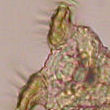
What astonished van Leeuwenhoek most was how these animals could be so
small yet have such intricate moving parts. The rotifer pictured here
has rotating parts and a darting movement through the water. And
millions are them are swimming around unseen in a few drops of canal
water. Van Leeuwenhoek called that number unbelievable. It was,
however, true.
|
Delft
View of Delft from the
west
This painting shows the magnificent gate called the Waterslootsepoort.
Hendrick Cornelisz. Vroom (1566-1640) painted this oil on canvas around
1615; it is currently on display in Delft at the Stedelijk Museum Het
Prinsenhof.
|
Burger
In 1655, a year after the Delft Thunderclap gunpowder explosion and
around the time van Leeuwenhoek was beginning his draper's business,
Jan Steen (1626-1679) painted this oil on canvas, "A Burgher of Delft
and His Daughter". Clearly, Steen tells us, some families in Delft were
more prosperous, and smug, than others. The Oude Kerk is in background,
so the burger's house was along the Oude Delft gracht.
|
St Lucas Guild
Hall of the St. Lucas Gilde off the main square in Delft, restored to
its 17th century form.
The St. Lucas Gilde was the largest and most important guild in Delft.
The guild, which had chapters in all the cities of the Republic, was
composed of artists and art dealers, house painters and decorators,
glass and pottery workers, and booksellers and printers. Only artists
who belonged to the guild had the legal right to sell their work in
Delft.
Van Leeuwenhoek belonged to the Sint Nicolaas Gilde for business
leaders, paying his incomste in 1655 (source: Burg and Leeuwenhoek).
However, he was step-son and brother-in-law to members of the St. Lucas
Gilde, and he dealt with other members throughout his life. His
interests complemented theirs: he sold the material artists painted on,
he developed extraordinary glass-grinding skills, and he self-published
his collected letters.
Van Leeuwenhoek's tendency to keep his tools and methods to himself, to
not share these "secrets", was fully in keeping with the guild ethos so
dominant during his time.
|
Aftermath of Delft
Thunderclap
Egbert van der Poel
A View of Delft after the Explosion of 1654
oil on canvas, around 1654
The sky, from where God threw His destructive thunder, dominates this
painting. Mere mortals, crushed under this sky, huddle in wonder,
remove their dead, and tend to their wounded in the rubble of their
once-proud city.
Early in van Leeuwenhoek's lifetime, most of the houses in Delft were
built of wood. In the summer of 1654, van Leeuwenhoek returned to Delft
from his apprenticeship in Amsterdam, bought one of those wooden
houses, the Gouden Hoofd, married, and started his drapery and
haberdashery business. That October, a gunpowder depot explosion,
called the Delft Thunderclap, killed hundreds of people, including
painter Carel Fabritius, and destroyed hundreds of wooden homes, mostly
in the ensuing fire. It was the most significant event in the city's
history since Willem was assassinated in 1584.
Within twenty years, the city had been largely re-built, of brick and
stone this time, and the population continued to grow. Businesses like
van Leeuwenhoek's would prosper under these conditions, too. His wooden
house was replaced with the current brick and stone structure much
later.
|
Ships
VOC frigate
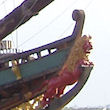
This is a replica of the VOC ship Batavia, built in 1628 and wrecked off Australia
on her maiden voyage. The survivors' story is one of the most renowned
shipwreck tales of that era.
Batavia was the Romans' word for the land north of the Rhine that was
the far frontier of their empire.
Fifteen hundred years later, the people of the new Dutch Republic, who
had never before considered each other countrymen, needed what the
sociologists call an "origin myth". The Batavians were the ones who did not
submit to the Romans, expressing virtues of independence, fortitude and
industry that the Dutch found attractive about themselves.
|
Herring ship
After Willem Beuckelszoon's invention of gibbing (partial gutting and
salting), the haring buis or herring ship let the Dutch go on
extended voyages to follow the herring and process it onboard. These
floating herring factories processed more than the Dutch people could
eat, creating an export industry for salt herring that was monopolized
by the Dutch throughout van Leeuwenhoek's lifetime.
|
|
Lens on Leeuwenhoek
Overview of the life, times, and work of
the developer of the single-lens microscope and
the first person to see bacteria and protozoa.
Antony van Leeuwenhoek, who lived three hundred years ago in
the Netherlands, saw things no one had ever seen before. He made
microscopes that were more powerful than the microscopes that everyone
else was using at the time. His microscopes let him see the tiniest
living things: We now call them sperm, red blood cells, protozoa, and
bacteria. They were everywhere, but they had no names.
Looking back, we can see their significance. But van
Leeuwenhoek could not. Everything that he saw, he was the first human
ever to see. Before then, in a world as rife with pseudo-scientific
speculation as ours, no one even imagined that the microscopic world
existed.
The first modern economy
Antony van Leeuwenhoek began making and using his lenses after
establishing himself as a cloth merchant and haberdasher in Delft, in
the late 1600's, the Golden Age of the Netherlands. The large ships and
brave, hardy sailors of the Dutch Republic ruled the world of commerce.
The country was called "the most learned state on earth" and produced
some of our best paintings, ever.
With their trustworthy financial instruments and international
information flow, their cosmopolitan tolerance and long tradition of
shared, distributed power, the Dutch used their ingenuity to develop
the world's highest standard of living and what some historians call
the first modern economy.
That economy created a growing, prosperous Delft where Antony
van Leeuwenhoek had the liberty to pursue the life of a disinterested,
though enthusiastic, and rigorous observer of the little world beyond
our sight and, until him, beyond our imagining.
Chatty letters
Van Leeuwenhoek did not begin to report his observations until
he was forty years old. However, he lived, and observed, until he was
past ninety. All of his reports, beginning in 1673, were chatty letters
to the editors of the journal of England's upstart Royal Society. In
1680, in recognition of his achievements, the Royal Society elected him
a Fellow. By his death in 1723, with over a hundred letters published
by the journal, he was their most-frequent author, and Delft's most
famous citizen, known and celebrated throughout Europe among scientists
and those interested in science.
Van Leeuwenhoek did not know that any of that would happen
when, already middle-aged, he began shaping his tiny lenses and
mounting them between palm-sized plates and then sticking things on the
little pin: plant parts, pond water, and slices of animals' internal
organs. He found a cabinet of curiosities and wonders in each specimen.
"What does it matter?"
He held the microscope as close to his eye as he could, angled
into the light, and concentrated. If he told others, perhaps they did
not have the patience and curiosity to hold the microscope steady or at
the correct angle. Perhaps their eyesight wasn't that good. In any
case, they did not always see what van Leeuwenhoek saw, tiny moving
animals, millions and millions of them, that had no name. He wrote:
Most go to make money out of science, or to
get a reputation in the learned world. But in lens-grinding and
discovering things hidden from our sight, these count for nought. ...
Most men are not curious to know: nay, some even make no bones about
saying, What does it matter whether we know this or not?
In the beginning then, Antony van Leeuwenhoek had a problem.
He was Adam in a microscopic Garden. What do you do when you see things
that no one has ever seen before?
|
Daily Life
in Holland
Social life
Adriaen van Ostade
The Violinist
Oil on canvas, 1672
Galleria Franchetti, Ca' d'Oro, Venice
Van Ostade (1610-1685), from Haarlem
in the northern part of Holland, close to the North Sea, painted scenes
of daily life. The people are relaxed, unposed, unaware that you're
watching, absorbed in the moment. He painted at a time when the days
and nights were quieter and all music was played live. The violinist
made these Dutch peasants share his smile and fill their tankards and
pipes. They all wore a hat or cap. Note the rough hewn boards and the
small window panes.
|
City life
Carel Fabritius (1622-1654) en | nl was a student of Rembrandt who settled in Delft
around 1650 but was to live until only 1654, dying at 31 in the Delft
Thunderclap, which also destroyed most of his paintings. In this 1652
painting, "A View of Delft with a Musical Instrument Seller's Stall",
it is hard to see any influence of Rembrandt. Fabritius seemed to be
developing his own style.
|
House
Jan Steen
The Dissolute Household
Oil on canvas, 1668
Wellington Museum, London
Jan Steen (1626-1679) en | nl was born in Leiden to a prosperous,
tavern-owning Catholic family. He lived in the Hague, Delft, Warmond,
and Haarlem and had two wives and nine children. He earned a good
living from his paintings, full of life, humor, and color.
In Dutch, een huishouden van Jan Steen means a messy scene.
Playing cards and oyster shells are strewn on the floor. A dog wags its
tail over a neglected roast. The pet monkey plays with the clock while
the boy snags a couple of coins from his mother's purse. Note the
long-stem, small-bowl pipe (tobacco was exotic and expensive), the
storage basket above the bed, and the valence over the fireplace.
|
Courtyard
Pieter de Hooch
The Courtyard of a House in Delft
oil on canvas, 1658
Pieter de Hooch (1629–1684) en | nl lived in Delft for a short time, and painted
The Courtyard of a House in Delft in 1658. It gives a sense of the
quiet peacefulness of everyday life in Delft during van Leeuwenhoek's
lifetime.
|
|